Never Again Take a Hike Pal

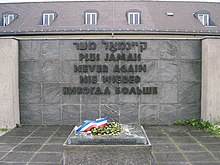
"Never once more" is a phrase or slogan which is associated with the Holocaust and other genocides. The phrase may originate from a 1927 poem by Yitzhak Lamdan which stated "Never again shall Masada fall!" In the context of genocide, the slogan was used by liberated prisoners at Buchenwald concentration camp to limited anti-fascist sentiment. The exact meaning of the phrase is debated, including whether it should exist used as a particularistic command to avert a 2nd Holocaust of Jews or whether it is a universalist injunction to prevent all forms of genocide. Information technology was adopted every bit a slogan past Meir Kahane'southward Jewish Defense League.
The phrase is widely used by politicians and writers and information technology also appears on many Holocaust memorials. Information technology has besides been appropriated as a political slogan for other causes, from commemoration of the 1976 Argentine coup, the promotion of gun control or abortion rights, and equally an injunction to fight against terrorism after the September 11 attacks.
Origins [edit]

During the liberation of Buchenwald, a sign states "Form the Antinazifront! Retrieve the Millions of victims Murdered by the Nazis / DEATH TO THE NAZI CRIMINALS"[1]

The slogan "Never again shall Masada fall!" is derived from a 1927 epic verse form, Masada, past Yitzhak Lamdan.[2] [3] The poem is about the siege of Masada, in which a group of Jewish rebels (the Sicarii) held out against Roman armies and, according to legend, committed mass suicide rather than be captured. In Zionism, the story of Masada became a national myth and was lauded as an instance of Jewish heroism. Considered i of the most significant examples of early Yishuv literature, Masada achieved massive popularity among Zionists in the land of Israel and in the Jewish diaspora. Masada became a function of the official Hebrew curriculum and the slogan became an unofficial national motto.[four] In postwar State of israel, the behavior of Jews during the Holocaust was unfavorably contrasted with the behavior of the defenders of Masada:[two] [3] the former were denigrated for having gone "similar sheep to the slaughter" while the latter were praised for their heroic and resolute fight.[5]
Betwixt 1941 and 1945, Nazi Deutschland and its allies murdered about half dozen 1000000 Jews in a genocide which became known equally the Holocaust.[6] The Nazi attempt to implement their final solution to the Jewish question took identify during World State of war II in Europe. The first use of the phrase "never again" in the context of the Holocaust was in April 1945 when newly liberated survivors at Buchenwald concentration camp displayed it in various languages on handmade signs.[vii] [8] Cultural studies scholars Diana I. Popescu and Tanja Schult write that there was initially a distinction betwixt political prisoners, who invoked "never over again" as part of their fight against fascism, and Jewish survivors, whose imperative was to "never forget" their murdered relatives and destroyed communities. They write that the stardom has been blurred in the subsequent decades every bit the Holocaust was universalised.[8] According to the United Nations, the Universal Declaration of Human being Rights was adopted in 1948 considering "the international community vowed never again to allow" the atrocities of World War Two, and the Genocide Convention was adopted the aforementioned year.[9] [x] Eric Sundquist notes that "the founding of State of israel was predicated on the injunction to remember a history of destruction—the destruction of 2 Temples, exile and pogroms, and the Holocaust—and to ensure that such events volition never happen over again".[ii] The slogan "never again" was used on Israeli kibbutzim by the end of the 1940s, and was used in the Swedish documentary Mein Kampf in 1961.[11]
Definition [edit]


Never Again! A Program for Survival (1972)
According to Hans Kellner, "Unpacking the semantic contents of 'Never Again' would be an enormous task. Suffice information technology to say that this phrase, despite its non-imperative form equally a speech act, orders someone to resolve that something shall not happen for a 2d time. The someone, in the offset instance, is a Jew; the something is usually chosen the Holocaust."[12] Kellner suggests that information technology is related to the "biblical imperative of memory" (zakhor), in Deuteronomy v:15, "And recollect that thou wast a servant in the land of Egypt, and that the Lord thy God brought thee out thence through a mighty hand and past a stretched out arm." (In the bible, this refers to remembering and keeping Shabbat).[12] It is also closely related to the biblical command in Exodus 23:9: "You shall not oppress a stranger, for you know the feelings of the stranger, having yourselves been strangers in the land of Arab republic of egypt."[thirteen]
The initial meaning of the phrase, used by Abba Kovner and other Holocaust survivors, was particular to the Jewish community merely the phrase's meaning was afterward broadened to other genocides.[thirteen] It is still a matter of contend whether "Never once again" refers primarily to Jews ("Never again can we allow Jews to exist victims of some other Holocaust") or whether it has a universal meaning ("Never once again shall the world allow genocide to accept place anywhere against any group"). However, most politicians use it in the latter sense.[vii] The phrase is used usually in postwar German politics, but it has different meanings. Co-ordinate to one interpretation, because Nazism was a synthesis of preexisting aspects of German language political thought and an farthermost form of ethnic nationalism, all forms of High german nationalism should be rejected. Other politicians contend that the Nazis "misused" appeals to patriotism and that a new German identity should be built.[14]
Writing nigh the phrase, Ellen Posman noted that "A past though frequently recent humiliation, and an emphasis on erstwhile victimhood, can lead to a communal desire for a prove of strength that tin easily turn vehement."[15] Meir Kahane, a far-correct rabbi, and his Jewish Defence League popularized the phrase. To Kahane and his followers, "Never over again" referred specifically to the Jews and its imperative to fight antisemitism was a telephone call to arms that justified terrorism confronting perceived enemies.[11] [3] [sixteen] The Jewish Defense League song included the passage "To our slaughtered brethren and lonely widows: / Never again volition our people's blood be shed by h2o, / Never again will such things be heard in Judea." After Kahane's decease in 1990, Sholom Comay, president of the American Jewish Commission, said "Despite our considerable differences, Meir Kahane must always be remembered for the slogan 'Never Again,' which for so many became the boxing cry of post-Holocaust Jewry."[11]
Gimmicky usage [edit]

Co-ordinate to Aaron Dorfman, "Since the Holocaust, the Jewish community'due south attitude toward preventing genocide has been summed upwards in the moral philosophy of 'Never Over again.'"[13] What this meant was that the Jews would not allow themselves to be victimized.[17] The phrase has been used in many official commemorations and appears on many Holocaust memorials and museums,[eight] [2] including memorials at Treblinka extermination camp[ii] and Dachau concentration camp,[eighteen] as well as in commemoration of the Rwanda genocide.[19]
It is in wide use by Holocaust survivors, politicians, writers, and other commentators, who invoke it for a variety of purposes.[7] [nineteen] In 2012, Elie Wiesel wrote: "'Never again' becomes more than a slogan: It's a prayer, a promise, a vow... never again the glorification of base, ugly, night violence." The United States Holocaust Memorial Museum made the phrase, in its universal sense, the theme of its 2013 Days of Remembrance, urging people to expect out for the "warning signs" of genocide.[11]

In 2016, Samuel Totten suggested that the "once powerful admonition [has] become a cliché" considering it is repeatedly used even as genocides go along to occur, and condemnation of genocide tends to just occur later information technology is already over.[seven] For an increasing number of critics, the phrase has become empty and overused.[8] Others, including Adama Dieng, have noted that genocide has continued to occur, not never again just "time and once again" or "again and once more" after World War II.[9] [xx] [21] [19] [vii] [17] In 2020, several critics of the Chinese government used the phrase to refer to the perceived lack of international reaction to the Uyghur genocide.[22] [23] [24] [25] On 1 March 2022, after the Babi Yar Holocaust Memorial Centre was hit by Russian missiles and shells during the battle of Kyiv, Ukraine'south President Volodymyr Zelenskyy argued that "never again" ways non being silent virtually Russia's aggression, lest history repeat itself.[26]
Multiple U.s. presidents, including Jimmy Carter in 1979, Ronald Reagan in 1984, George H. W. Bush in 1991, Bill Clinton in 1993, and Barack Obama in 2011, have promised that the Holocaust would non happen again, and that action would exist forthcoming to stop genocide.[19] [9] [eleven] Even so, genocide occurred during their presidencies: Kingdom of cambodia in Carter's case, Anfal genocide during Reagan'southward presidency, Bosnia for Bush and Clinton, Rwanda under Clinton, and Yazidi genocide for Obama.[27] [ix] Elie Wiesel wrote that if "never again" were upheld "at that place would be no Cambodia, and no Rwanda and no Darfur and no Bosnia."[28] Totten argued that the phrase would merely recover its gravitas if "no one just those who are truly serious well-nigh preventing another Holocaust" invoked it.[7]
Other uses [edit]


In Argentina, the phrase Nunca más (never more) is used in annual commemorations of the 1976 Argentine insurrection, to emphasize continued opposition to military coups, dictatorship, and political violence, and a delivery to democracy and human rights.[29] [xxx] "Never again" has also been used in commemoration of Japanese American internment and the Chinese Exclusion Act.[11]
After the September 11 attacks, President George W. Bush-league alleged that terrorism would be allowed to triumph "never again". He referenced the phrase when defending the trial of non-citizens in military machine courts for terrorism-related offenses and mass surveillance policies adopted by his administration. Bush commented, "Foreign terrorists and agents must never over again be allowed to apply our freedoms against united states of america." His words echoed a spoken communication that his father had given after winning the Gulf War: "never again be held earnest to the darker side of homo nature".[31]
The phrase has been used past political advocacy groups Never Once again Action, which opposes immigration detention in the United states, and by Never Once more MSD, a group that campaigns against gun violence in the wake of the Stoneman Douglas shooting.[11] [32]
See also [edit]
- Responsibility to protect
- The war to end state of war
- Never forget
- Lest we forget
References [edit]
- ^ "A sign posted [probably in Buchenwald] that says, "Grade the Antinazifront! Call back the Millions of victims Murdered by the Nazis/ Death TO THE NAZI CRIMINALS." - Collections Search - U.s. Holocaust Memorial Museum". collections.ushmm.org. Archived from the original on iv June 2020. Retrieved 29 May 2020.
- ^ a b c d e Sundquist, Eric J. (2009). Strangers in the State: Blacks, Jews, Post-Holocaust America. Harvard Academy Press. p. 601. ISBN978-0-674-04414-2. Archived from the original on 9 July 2021. Retrieved xix October 2020.
- ^ a b c Philologos (vi May 2020). "What Is the Source of the Phrase "Never Again"?". Mosaic Magazine. Archived from the original on 17 Apr 2020. Retrieved vi May 2020.
- ^ Zerubavel, Yael (1995). Recovered Roots: Commonage Retention and the Making of Israeli National Tradition. University of Chicago Printing. pp. 69, 116, 258. ISBN978-0-226-98157-four. Archived from the original on 9 July 2021. Retrieved ten May 2020.
- ^ Feldman, Yael Southward. (2013). ""Not as Sheep Led to Slaughter"? On Trauma, Selective Retentivity, and the Making of Historical Consciousness". Jewish Social Studies. 19 (3): 139–169. doi:10.2979/jewisocistud.19.3.139. ISSN 0021-6704. JSTOR ten.2979/jewisocistud.19.3.139. S2CID 162015828.
- ^ "Introduction to the Holocaust". Holocaust Encyclopedia. U.s.a. Holocaust Memorial Museum. 12 March 2018. Archived from the original on 11 October 2015. Retrieved 10 May 2020.
- ^ a b c d e f Totten, Samuel (2016). "What Near "Other" Genocides? An Educator's Dilemma or an Educator's Opportunity?". Essentials of Holocaust Education: Fundamental Issues and Approaches. Routledge. p. 197. ISBN978-i-317-64808-vi. Archived from the original on 1 February 2022. Retrieved 19 October 2020.
- ^ a b c d Popescu, Diana I.; Schult, Tanja (2019). "Performative Holocaust celebration in the 21st century". Holocaust Studies. 26 (2): 135–136. doi:10.1080/17504902.2019.1578452.
- ^ a b c d Ability, Samantha (1998). "Never Again: The Earth'due south Well-nigh Unfullfilled Hope | The World's Most Wanted Man". Frontline. PBS. Archived from the original on 25 May 2020. Retrieved seven May 2020.
- ^ "Universal Declaration". United Nations. Archived from the original on 27 May 2020. Retrieved 7 May 2020.
- ^ a b c d e f yard "How the Holocaust motto Never Once again became a rallying cry for gun command". Jewish Telegraphic Agency. viii March 2018. Archived from the original on 24 October 2019. Retrieved 6 May 2020.
- ^ a b Kellner, Hans (1994). ""Never Again" is At present". History and Theory. 33 (2): 127–128. doi:10.2307/2505381. ISSN 0018-2656. JSTOR 2505381.
- ^ a b c Dorfman, Aaron. "Responding to Genocide". My Jewish Learning. Archived from the original on 20 August 2016. Retrieved vi May 2020.
- ^ Fine art, David (2005). The Politics of the Nazi By in Germany and Republic of austria. Cambridge University Press. p. xx. ISBN978-i-139-44883-3. Archived from the original on 9 July 2021. Retrieved xix October 2020.
- ^ Posman, Ellen (2011). "Introduction: Never Again". In Tater, Andrew R. (ed.). The Blackwell Companion to Organized religion and Violence. John Wiley & Sons. ISBN978-1-4443-9573-0. Archived from the original on i February 2022. Retrieved 19 Oct 2020.
- ^ School, Lee C. Bollinger Dean Academy of Michigan Law (1986). The Tolerant Order. Oxford University Press, USA. p. 274. ISBN978-0-xix-802104-9. Archived from the original on 9 July 2021. Retrieved nineteen Oct 2020.
- ^ a b Gubkin, Liora (2007). You Shall Tell Your Children: Holocaust Memory in American Passover Ritual. Rutgers University Printing. p. 117. ISBN978-0-8135-4390-one. Archived from the original on 9 July 2021. Retrieved nineteen October 2020.
- ^ Baer, Alejandro; Sznaider, Natan (2016). Memory and Forgetting in the Postal service-Holocaust Era: The Ethics of Never Once more. Routledge. ISBN978-1-317-03375-two. Archived from the original on 4 June 2020. Retrieved vii May 2020.
- ^ a b c d Buettner, Angi (2016). "Never once again: Rwanda, genocide, and the Holocaust". Holocaust Images and Picturing Ending: The Cultural Politics of Seeing. Routledge. p. 85. ISBN978-ane-351-93052-ix. Archived from the original on 31 January 2022. Retrieved xix October 2020.
- ^ "Genocide: "Never again" has become "fourth dimension and over again"". Part of the Un High Commissioner for Human Rights. xviii September 2018. Archived from the original on 4 June 2020. Retrieved 6 May 2020.
- ^ McCallum, Luke (half-dozen April 2019). "Publications". International Association of Genocide Scholars. Archived from the original on 23 May 2020. Retrieved 7 May 2020.
The twentieth century has been called "The Age of Genocide." In the aftermath of the Holocaust, the slogan "never again" was coined; yet since 1945 nosotros have seen the mass slaughter of Bengalis, Cambodians, Rwandans, Bosnians, Kosovars, and Darfuris, to name only a few.
- ^ Ibrahim, Azeem (three December 2019). "China Must Answer for Cultural Genocide in Court". Foreign Policy. Archived from the original on 20 Jan 2020. Retrieved iii February 2021.
- ^ Dolkun, Isa (14 September 2020). "Europe said 'never once again.' Why is it silent on Uighur genocide?". Politico. Archived from the original on three March 2021. Retrieved 3 February 2021.
- ^ Sartor, Nina (three December 2020). ""Never Again" all over again". The Silhouette. Archived from the original on 7 Feb 2021. Retrieved 3 February 2021.
- ^ Kaye, Jonah (23 Baronial 2020). "Uyghur Camps And The Meaning Of 'Never Once again'". The Detroit Jewish News. Archived from the original on 7 March 2021. Retrieved iii February 2021.
- ^ Harkov, Lahav (1 March 2022). "Russia strikes Babyn Yar Holocaust memorial site in Ukraine". The Jerusalem Post . Retrieved i March 2022.
- ^ Fishel, Justin (17 March 2016). "ISIS Has Committed Genocide, Obama Assistants Declares". ABC News. Archived from the original on x January 2020. Retrieved 7 May 2020.
- ^ Rieff, David (ane Feb 2011). "The Persistence of Genocide". Hoover Establishment. Archived from the original on 23 April 2020. Retrieved 6 May 2020.
- ^ Fernández Meijide, Graciela (24 March 2020). ""Nunca más", un compromiso vigente". Infobae (in European Castilian). Archived from the original on 24 March 2020. Retrieved 6 May 2020.
- ^ "Día de la Memoria en Argentina: el necesario recuerdo de la dictadura". France 24. 24 March 2019. Archived from the original on 18 December 2019. Retrieved 6 May 2020.
- ^ Schneider, Rebecca (2006). "Never, Once again". In Hamera, Judith A. (ed.). The SAGE Handbook of Performance Studies. SAGE. p. 25. ISBN978-0-7619-2931-4. Archived from the original on i February 2022. Retrieved 19 Oct 2020.
- ^ "Jews Protesting Detention Centers: Inside Never Over again Action". Jewish Journal. 17 July 2019. Archived from the original on 23 April 2020. Retrieved 6 May 2020.
External links [edit]
tarkingtonhattond.blogspot.com
Source: https://en.wikipedia.org/wiki/Never_again

Postar um comentário for "Never Again Take a Hike Pal"